
Evangeline Parish Court Records After Arrest
A local arrest creates a jail booking record first. The court record comes next, after prosecutor review and filing. Evangeline Parish is served by the 13th Judicial District Court, and the 13th Judicial District Attorney prosecutes state criminal cases that arise in the parish. The Evangeline Parish Clerk of Court is the court-record anchor for case files, certified copies, older filings, and records that do not appear in an online search.
The booking side and the court side should not be blended. For custody, booking number, booking date, arresting agency, bond line, or jail roster status, use Evangeline Parish jail inmate records. For booking photos, use Evangeline Parish jail mugshots. For court records after a jail arrest, look for the filed charge, case number, court dates, motions, plea, disposition, and sentence entries through the clerk and court channels.
Evangeline Parish Court Path
The practical path is: arrest, booking, first appearance, prosecutor filing, court case, charge status, disposition, and sentence if there is a conviction. The jail roster may show arrest charges before a court case is filed. Those arrest charges can later be amended, reduced, dismissed, or replaced by formal charges. A very new arrest may not have a matching case record right away because the court file depends on filing and clerk entry.
- Start with the jail roster only to collect the booked name, booking date, arresting agency, charges, and booking number.
- Allow time for prosecutor and clerk processing if the arrest is recent.
- Search Clerk Connect or contact the Evangeline Parish Clerk of Court by defendant name and case number if known.
- Use the 13th Judicial District Court site for court-level information and routing.
- Use the District Attorney site for prosecution information, not for certified copies of the court file.
- Request certified copies or older nononline records through the Clerk of Court.
No official Evangeline Parish sheriff mobile app with an app-only inmate lookup was confirmed in the research sweep. If the immediate question is still custody rather than court filing, use the sheriff roster, the jail phone line, Louisiana DOC, VINELink, BOP, or ICE as the person's custody status requires. Those systems can show where a person is held, while the clerk and court channels show the case record after filing.
Evangeline Parish Clerk Connect Search
The Evangeline Parish Clerk of Court site and Clerk Connect are the court-record access channels identified in the research. Clerk Connect is a Louisiana clerk portal used by participating clerks, but access can vary by parish, record type, account status, and whether images or advanced search tools require clerk-controlled permission. In-person or mail contact remains the fallback for certified records, older cases, and records that the portal does not expose.
| Field Label | Type | Required | Options or Format Notes |
|---|---|---|---|
| Parish or clerk selection | Dropdown/search | Required for local records | Choose the participating parish or office when available. |
| Name | Text | Optional or required by search | Search defendant or litigant names where criminal indexes are enabled. |
| Case number | Text | Optional | Best when known from court paperwork or a jail/court notice. |
| Date range | Date fields | Optional | Use filing or recording date filters if the portal offers them. |
| Record type | Dropdown/tab | Optional | Civil, criminal, land, mortgage, marriage, and other modules may vary. |
| Login/account | Account fields | Sometimes | Advanced access, images, or subscriptions may be required. |
The Clerk Connect screenshot below comes from the manifest row for the court-record portal.
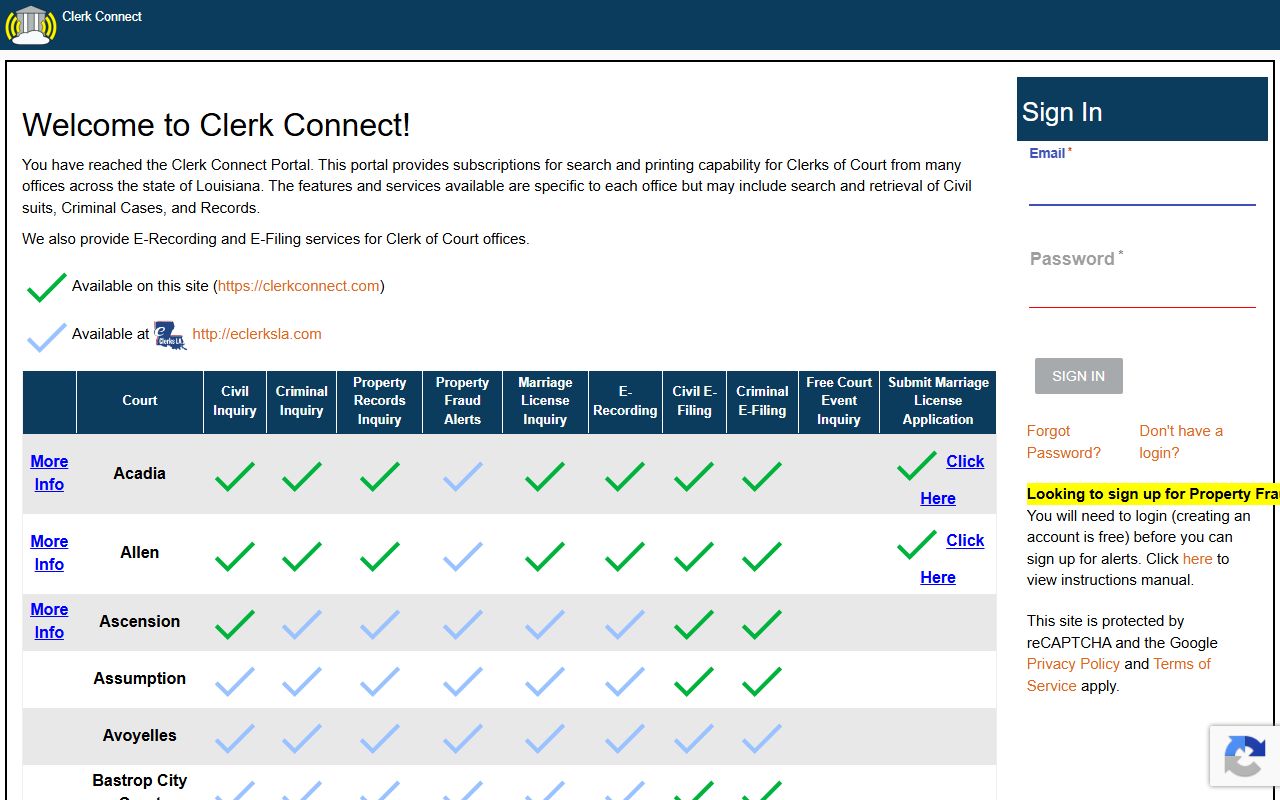
Use the portal for index searching when available, then use the clerk for certified copies or case-file access that the portal does not provide.
Evangeline Parish Charging Documents
Court records after a jail arrest turn on the charging document. The jail may list the arrest charge, but the court file reflects what the prosecutor files and what the court accepts for processing. Louisiana practice includes complaints, bills of information, indictments, amendments, reductions, dismissals, and nolle prosequi entries. Nolle prosequi means the prosecutor declines or dismisses a charge.
| Document | Who Uses It | What It Means | Search Tip |
|---|---|---|---|
| Complaint | Officer or prosecutor | An initial accusation or sworn allegation used in early proceedings. | May appear before later formal filing. |
| Bill of information | Prosecutor | A prosecutor-filed formal charge used in many Louisiana felony cases. | Compare it against the roster charge list. |
| Indictment | Grand jury | A grand-jury formal charge. | Often tied to more serious felony prosecution. |
Evangeline Parish Charge Status
A court case can change after the first filing. The District Attorney may amend a charge, reduce it, add a count, or dismiss it. A judge may set or change bond, issue a bench warrant, accept a plea, or sentence after conviction. Because of those changes, an Evangeline Parish court records after arrest search should read each count separately and avoid treating the first booking charge as the final outcome.
| Status | What It Means | Why It Matters |
|---|---|---|
| Pending | The charge is still open or awaiting a court event. | The case has no final disposition yet. |
| Amended | The prosecutor changed the charge or count. | The court charge may differ from the jail roster charge. |
| Reduced | The charge level or offense was lowered. | Sentencing exposure and case meaning can change. |
| Dismissed | The charge is not moving forward as filed. | Dismissal is not the same as conviction. |
| Nolle prosequi | The prosecutor declined or dismissed the charge. | The record may still show the filing and dismissal event. |
| Disposition | The current or final outcome of a charge. | This is the field to read before drawing conclusions. |
Evangeline Parish Bond and Warrants
Bond can appear on the jail roster, but release conditions are controlled by the court. Louisiana bond types include cash, surety, property, personal recognizance, and no-bond or hold situations. A surety bond uses a licensed bail agent. A personal recognizance release is based on a promise to appear and court conditions. A hold or detainer means another agency or legal reason may block release even when a dollar bond appears.
The sheriff site includes an Evangeline Parish warrants page. If the public page is empty or unavailable at a given time, that does not prove no warrant exists. Bench warrants tied to failure to appear can be reflected in the court case. Arrest warrants can lead to jail booking. Search warrants are different because they authorize a search, not a jail lookup.
- Detainer
- A request or notice from another agency to hold or notify before release.
- First appearance
- An early court hearing for rights, bond, and basic case handling.
- Bench warrant
- A judge-issued warrant, often after a missed court date.
Evangeline Parish Charges vs Convictions
An arrest, a booking charge, and a filed charge are not convictions. A conviction requires a guilty plea, verdict, or other final adjudication that produces a disposition. Court records after a jail arrest can show allegations, filings, amendments, hearings, warrants, and dismissed charges. Read the final status before using a court record to describe what happened.
| Record Point | Charge | Conviction |
|---|---|---|
| Stage | An allegation at booking or filing. | A final plea, verdict, or adjudicated outcome. |
| Source | Roster, complaint, information, or indictment. | Court disposition and sentencing entry. |
| Meaning | The state claims an offense occurred. | The case ended with guilt or an equivalent legal outcome. |
| Search risk | May later be changed or dropped. | Still should be verified with the clerk record. |
Evangeline Parish Sealed vs Expunged
Louisiana public-record access is broad, but it has limits. Juvenile records, protected victim information, medical details, security-sensitive information, active investigative material, and sealed or restricted records may be withheld or redacted. Louisiana R.S. 44:3 is the key law-enforcement records statute in the research, while R.S. 44:31 gives the general right to inspect or copy public records unless an exception applies.
| Issue | Sealed | Expunged |
|---|---|---|
| Public visibility | Hidden or restricted from general public view. | Treated through the applicable record-clearing process. |
| Agency access | Some official access may remain where law allows. | Official handling depends on the court order and Louisiana law. |
| Where to verify | Clerk of Court and case file. | Clerk of Court and the signed order. |
| Roster effect | May not remove older web copies by itself. | Use the official court and custodian route, not a commercial removal claim. |
Important: Public access does not mean every case detail is public. Verify sealed, expunged, juvenile, and active-investigation limits with the clerk or custodian.
Evangeline Parish Court Offices
The court record path uses several offices, and each has a different role. The clerk keeps the case file and certified copies. The 13th Judicial District Court is the court system serving Evangeline Parish. The District Attorney decides what charges to file, whether to amend charges, and whether to dismiss or proceed. The DA does not operate the jail roster and is not the custodian of booking photos.
The 13th Judicial District Attorney site is the prosecution source identified in the research. The screenshot below documents that prosecution-office channel for Evangeline Parish court records after an arrest.

Use the DA site for prosecution context and victim-services routing when available, while the clerk remains the route for certified court records and older files.
The clerk, court, and prosecutor also answer different timing questions. The jail roster may update soon after booking, but the court record may lag until a complaint, bill of information, indictment, or other filing is entered. The DA can explain prosecution-side programs or victim-services contacts when published, yet certified copies and docket entries still come from the clerk. Keeping those roles separate prevents a jail arrest from being mistaken for a final court result.